Rediscovering Adam Smith
The Two-Book Smith

I spent the past three weeks at conferences marking the 250th anniversary of The Wealth of Nations. What surprised me most was that we were not really celebrating The Wealth of Nations, we were celebrating Adam Smith, and, in particular, The Theory of Moral Sentiments.
Perhaps every generation creates the Adam Smith it needs. Around the bicentenary of The Wealth of Nations in 1976, Smith was widely presented as the champion of markets and self-interest. Today’s Smith is more likely to be read as a moral philosopher, a theorist of institutions and justice, and a student of human behaviour. His economics has not disappeared, but it is increasingly understood as part of a much larger and broader intellectual project.
An Inquiry into the Nature and Causes of the Wealth of Nations is considered a classic in academic and financial circuits, but as William Barber wryly surmised, it ‘has suffered the fate accorded to most classics: it is more talked about than read.’[i] Outside universities, Smith is still widely caricatured as the apostle of greed and laissez-faire. Yet among Smith scholars, the ‘two-book’ Smith is the norm. The Theory of Moral Sentiments is no longer treated as a prelude to The Wealth of Nations, but seen as the key to understanding it.
I was fortunate to spend the past three weeks at different conferences in Edinburgh and Glasgow commemorating the 250th anniversary of the publication of the Wealth of Nations. Other colleagues have reflected on these conferences (see posts by Robbie Mochrie and Lesley Niezynski), my contribution is limited to the observation on the importance of the ‘two-book’ Smith and how the Theory of Moral Sentiments featured as much, if not more so, than the Wealth of Nations in these celebrations.
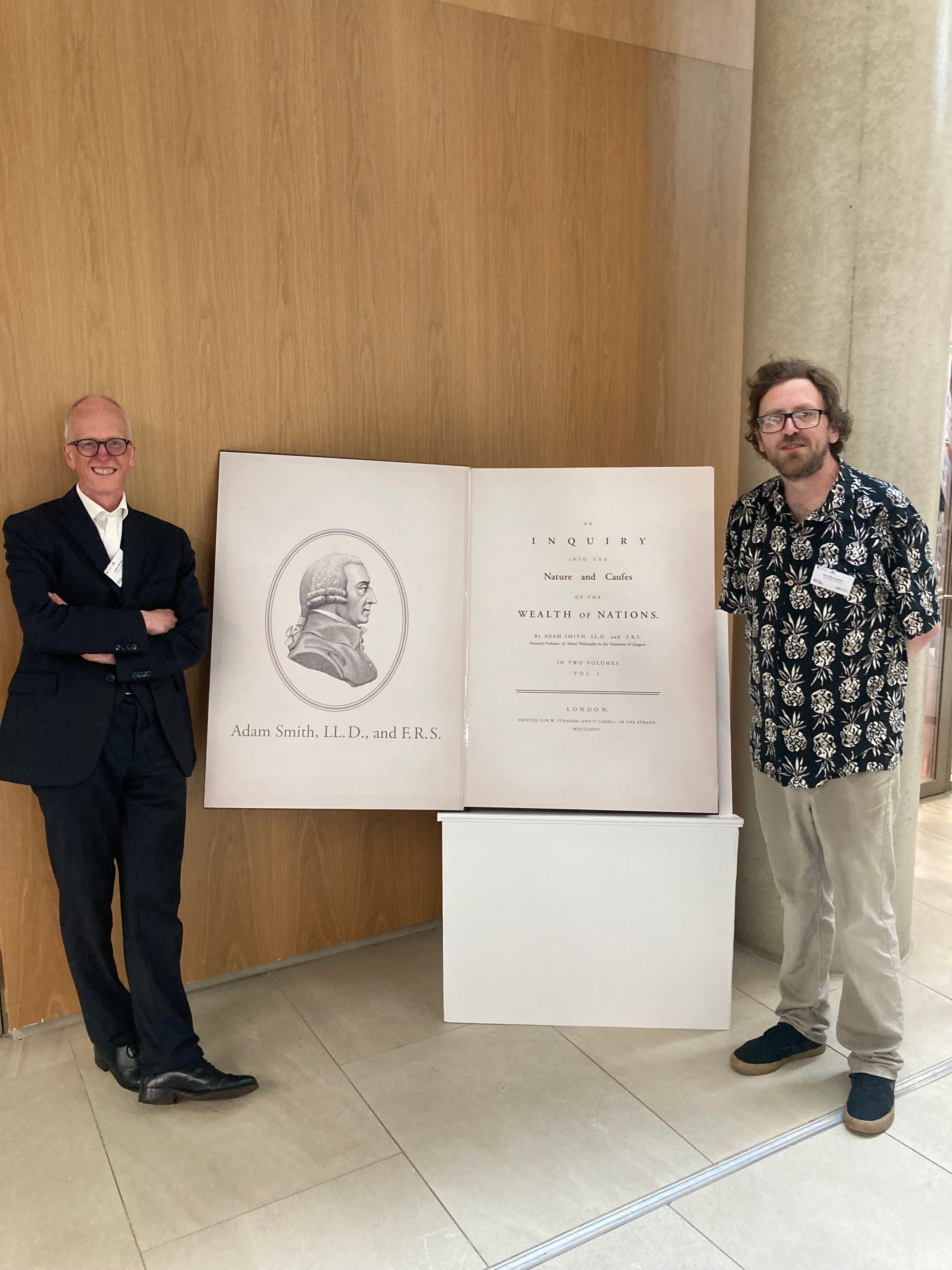
The first conference I attended was hosted by Panmure House and was entitled ‘The New Enlightenment Conference’. Panmure House keen Smithian scholars will observe was his former residence in the city of Edinburgh, close to where he was buried. The second was held at the University of Glasgow, The World in 1776/2026, where Smith wrote his famous treatise, The Theory of Moral Sentiments, first published in 1759. He resigned his professorship from Glasgow in 1763 to take on the tutorage of the young Duke of Buccleuch, and in his new role he toured Europe and met with the leading French philosophers of his day.[ii] The final conference was on the Legacy of Adam Smith and was held at the Library of Mistakes in Edinburgh.
Man for All Disciplines
Smith did not write The Wealth of Nations in isolation, he drafted much of The Wealth of Nations while travelling in France before returning to Kirkcaldy to finish it. The book grew out of the wider European Enlightenment rather than a purely Scottish intellectual tradition.
The Smith discussed in Edinburgh and Glasgow was a moral philosopher, a historian, a student of institutions and justice, whose economics cannot easily be separated from his ethics. Smith was an interdisciplinarian because when he was writing disciplines had not yet formed. Ironically, it was specialism from the division of labour that has forced academics to narrow their attention over time. At the academic conferences I was struck by the range of academic disciplines represented from philosophy to political science, with some linguistics thrown in, not to mention economists; although economists were in the minority.
What struck me most was not simply how often The Theory of Moral Sentiments was mentioned, but how little this surprised the audience (well a few libertarians aside!) and perhaps there would have been greater surprise if it was omitted. Among Smith scholars, the ‘two-book Smith’ is now almost taken for granted. That is a remarkable change because at the bicentenary of The Wealth of Nations in 1976, much of the debate still revolved around Smith as the champion of self-interest and free markets. Modern scholarship increasingly rejects what Amartya Sen called the ‘one-idea capsule summary’ of Smith and instead sees The Wealth of Nations and The Theory of Moral Sentiments as parts of a single intellectual project.
Two-book man
Adam Smith’s An Inquiry into the Nature and Causes of the Wealth of Nations is the landmark text in economics and one of the most influential books written in the past 250 years. While the book is seen as kick starting an intellectual revolution, the evolution of economic thinking and writing since the time of Smith has lost many of his messages and the nuances inherent in his thinking. The Wealth of Nations was part of his broader intellectual project and this was demonstrated clearly in the preface of the sixth (and final) edition of his Theory of Moral Sentiments (the final work that Smith choose to revisit before his death), where an elderly Smith reflected on how he had set out to write on the principles of law and government, the ‘different revolutions’ that society had undergone in terms of justice, and ‘what concerns police, revenue and arms, and whatever else is the object of the law’. Smith said he had ‘partially executed his promise’ in the Wealth of Nations and had hoped to continue it, but he was already at an advanced age at that point.
In fact, one of the biggest changes in the twentieth century has been the re-appreciation of Adam Smith the moral philosopher. Writing at the 150th anniversary of the Wealth of Nations, James Bonar completely disregarded The Theory of Moral Sentiments, arguing that the ‘memory [of it] was kept alive’ because of the success of the Wealth of Nations. Similarly, William Barber dismissed The Theory of Moral Sentiments as having had, ‘little distinction as a contribution to philosophy’. Whereas in the twenty-first century both Roger Backhouse and Robbie Mochrie see the arguments that were developed in The Theory of Moral Sentiments as being pivotal in Smith’s understanding of capital formation amongst many other things. The dismissal of the Theory of Moral Sentiments by Bonar and Barber is not surprising as many economists have seen the two as unrelated works with criticism of the Wealth of Nations overlooking The Theory of Moral Sentiments. For example, at the bicentennial of the Wealth of Nations, it had been argued that Smith had a ‘pernicious legacy’, but here it is clear that this criticism was based on a narrow reading of Smith from the Wealth of Nations and not what is elaborated in the Theory of Moral Sentiments.[iii]
Even the language tells the story. The Wealth of Nations revolves around labour, markets, prices and capital (see word cloud in an earlier post) while The Theory of Moral Sentiments revolves around sympathy, justice, virtue and conscience. They look like different books because they ask different questions but together they ask a larger one: how do prosperous societies emerge from human beings who are simultaneously economic and moral creatures?
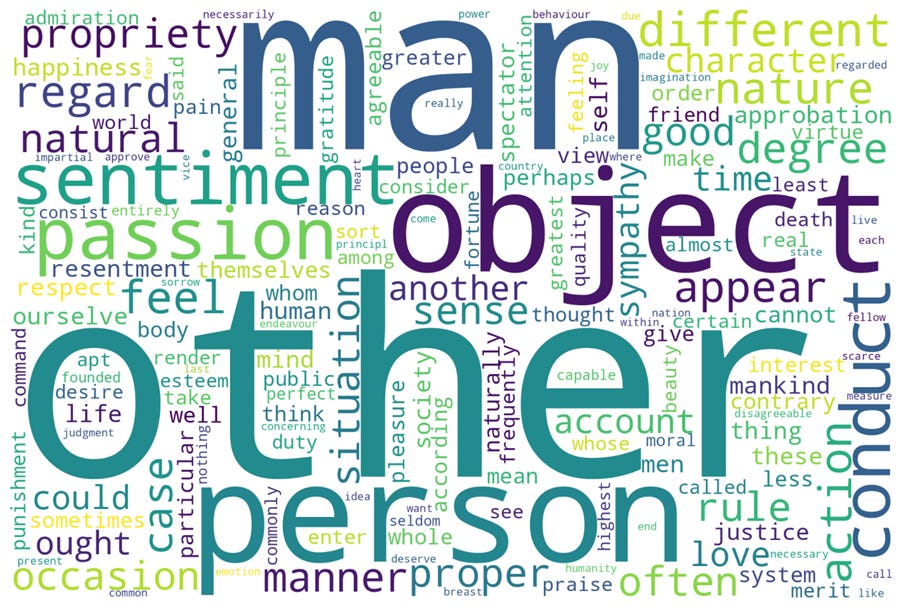
Note: The word clouds are based on cleaned frequency counts rather than raw text. Common function words (such as “the” and “and”), OCR artefacts, and duplicate word forms were removed or merged so that the visualisations highlight Smith’s substantive concepts rather than the mechanics of eighteenth-century English
It is the Theory of Moral Sentiments where Smith first invoked the concept of ‘an invisible hand’ as the mechanism that ‘advance the interest of the society’. Smith saw this as a way that society had ordered itself through the actions of the poor to emulate the rich as this had led to:
It is this deception [that the poor can emulate the rich in achieving convenience] which rouses and keeps in continual motion the industry of mankind. It is this which first prompted them to cultivate the ground, to build houses, to found cities and commonwealths, and to invent and improve all the sciences and arts, which ennoble and embellish human life; which have entirely changed the whole face of the globe, have turned the rude forests of nature into agreeable and fertile plains, and made the trackless and barren ocean a new fund of subsistence, and the great high road of communication to the different nations of the earth. The earth by these labours of mankind has been obliged to redouble her natural fertility, and to maintain a greater multitude of inhabitants.[iv]
In sum, it was ‘an invisible hand’ that Smith envisaged was what drove economic growth and overcame limits. Significantly, Smith referred to ‘an’ invisible hand rather than ‘the’ invisible hand. The metaphor was not presented as a universal law of markets, but as one way in which unintended consequences could advance the interests of society.
Finding Smith

My own work started as an attempt to see where the wealth of nations was today (see an early piece I wrote for the tercentenary conferences back in 2023). Kenneth Boulding, one of the founding figures in Sustainability Science, was a huge fan of Adam Smith and argued that one can glean new insights from Smith by reading him afresh and that we should study the classics ‘from the point of view of what they have to say to us today, rather than from the point of view of what their place is in the historical record’.
Looking back, perhaps I should not have been surprised that The Theory of Moral Sentiments dominated the anniversary celebrations. That was precisely the journey I found myself making; I began by asking where the wealth of nations comes from. I ended by realising that Smith himself thought that question could never be separated from a more fundamental one: what kind of society do we wish to become?
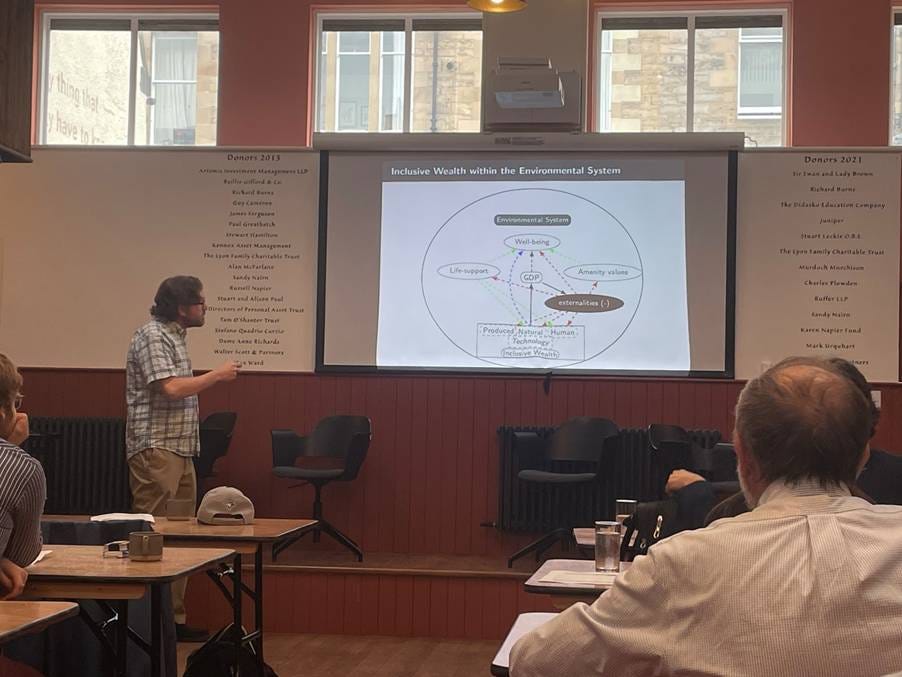
One of my favourite passages from the Wealth of Nations reads almost like an echo of the impartial spectator from the Theory of Moral Sentiments:
No society can surely be flourishing and happy, of which the far greater part of the members are poor and miserable. It is but equity, besides, that they who feed, clothe, and lodge the whole body of the people, should have such a share of the produce of their own labour as to be themselves tolerably well fed, clothed, and lodged.[v]
Equity, I would argue, lies at the heart of the Wealth of Nations.
[i] W. J. Barber (1967). A History of Economic Thought. Middlesex: Penguin, p. 23.
[ii] Adam Smith (1776), An inquiry into the Nature and Causes of the Wealth of Nations. A select edition. Ed. Kathryn Sutherland (1998). Oxford: Oxford University Press.
[iii] R. S. Franklin (1976). Smithian economics and its pernicious legacy. Review of Social Economy, 34 (3): 379-389
[iv] TMS, part iv, chapter i.
[v] Smith, WON, book I, c viii.
I've been recommending audio books if people havent had time to read through his books. Happy to chat re your book, just send me an email (E.McLaughlin at hw)
Not read any of Smiths work but having grown up 4 miles from Kirkcaldy was aware of him from quite an early age. In reference to the question posed in your article “What type of society do we wish to become” would welcome your personal thoughts as an economist as part of the research I am doing for my book “Collaboration Dawn” , an exploration of how we can work together more effectively at a local, regional, national and global level.