Adam Smith, Capital, and Existential Risk
Why is The Wealth of Nations important today?

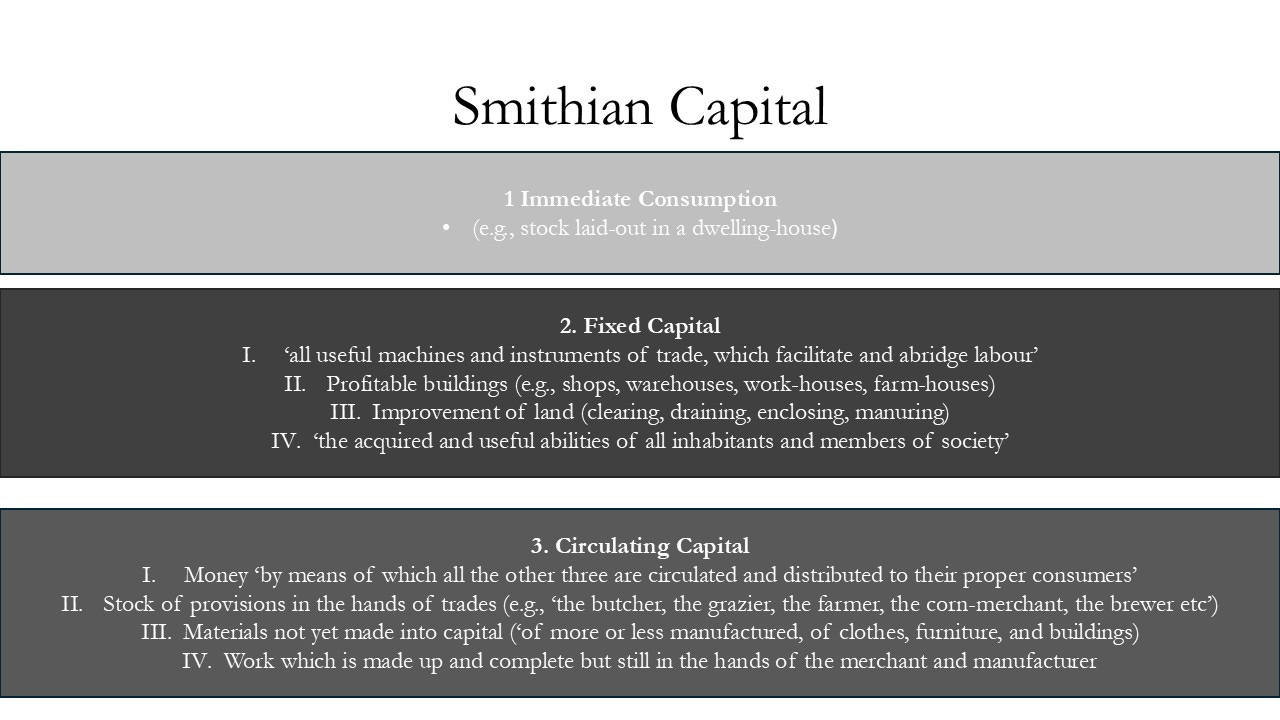
“To maintain and augment the stock which may be reserved for immediate consumption is the sole end and purpose both of the fixed and circulating capitals. It is this stock which feeds, clothes, and lodges the people. Their riches or poverty depends upon the abundant or sparing supplies which those two capitals can afford to the stock reserved for immediate consumption.”
That line from Adam Smith gets to the heart of The Wealth of Nations. It’s also a useful place to start.
I am heading to a roundtable at the Adam Smith Heritage Centre in his hometown of Kirkcaldy to discuss a simple topic: why does this book still matter?
Part of the answer is that how we define wealth shapes how we think about risk, including the kinds of risks that could undermine or even end modern economic life.
But there is something more basic in Smith’s work that’s worth revisiting: what actually counts as the “wealth” of a nation.
An Inquiry into the Nature and Cause of the Wealth of Nations is made up of five books, but most people stop at Book I. That’s where Smith introduces the Division of Labour (a concept that was heavily influenced by Francis Hutcheson, Smith’s predecessor as chair of Moral Philosophy at the University of Glasgow). Specialisation is the engine of productivity. It’s the idea that underpins modern economic life.
Chapter 3 of Book I sets out the key constraint: the division of labour is limited by the extent of the market.
“When the market is very small, no person can have any encouragement to dedicate himself entirely to one employment, for want of the power to exchange all that surplus part of the produce of his own labour, which is over and above his own consumption, for such parts of the produce of other men’s labour as he has occasion for.”
In the 18th century, markets were constrained by distance: sail ships, horse travel, slow communication. Today, digital markets stretch to something close to global scale. The constraint hasn’t disappeared, but it has shifted.
Where is the Wealth of Nations?
Smith wasn’t just interested in how economies grow. He was arguing against a deeper mistake: confusing money with wealth. He pushes back against the mercantilist view that gold and silver define national prosperity. Instead, wealth lies in the real assets of a society, its land, buildings, and the goods it produces.
This leads to Book II, which is where his argument becomes more interesting. Wealth, for Smith, sits in what he calls “stock” (and what we would now call capital). It is capital that makes the division of labour possible. Without accumulated stock, there is no specialisation, no scaling up of production, no sustained growth.
“As the accumulation of stock must, in the nature of things, be previous to the division of labour, so labour can be more and more subdivided in proportion only as stock is previously more and more accumulated…The quantity of industry, therefore, not only increases in every country with the increase of the stock which employs it, but, in consequence of that increase, the same quantity of industry produces a much greater quantity of work.”
This is the core of Smithian economics: accumulation comes first. Everything else follows.
What is the “Stock”?
Smith breaks capital down into different forms (see figure 1). Some of it is fixed (machines, buildings, infrastructure), some of it circulates (inputs, wages, working capital), but the key point is that capital feeds on itself. Apply capital to land, mines, and fisheries and you get more output, which in turn becomes new capital.
Even in Smith’s time, this interaction mattered. Coal mining, for example, depended on capital-intensive technologies like steam engines just to reach deeper seams. And crucially, capital isn’t self-sustaining. It has to be replenished. The ultimate source of that replenishment, in Smith’s framework, is what we would now call natural capital: the “produce of land, of mines, and of fisheries.”
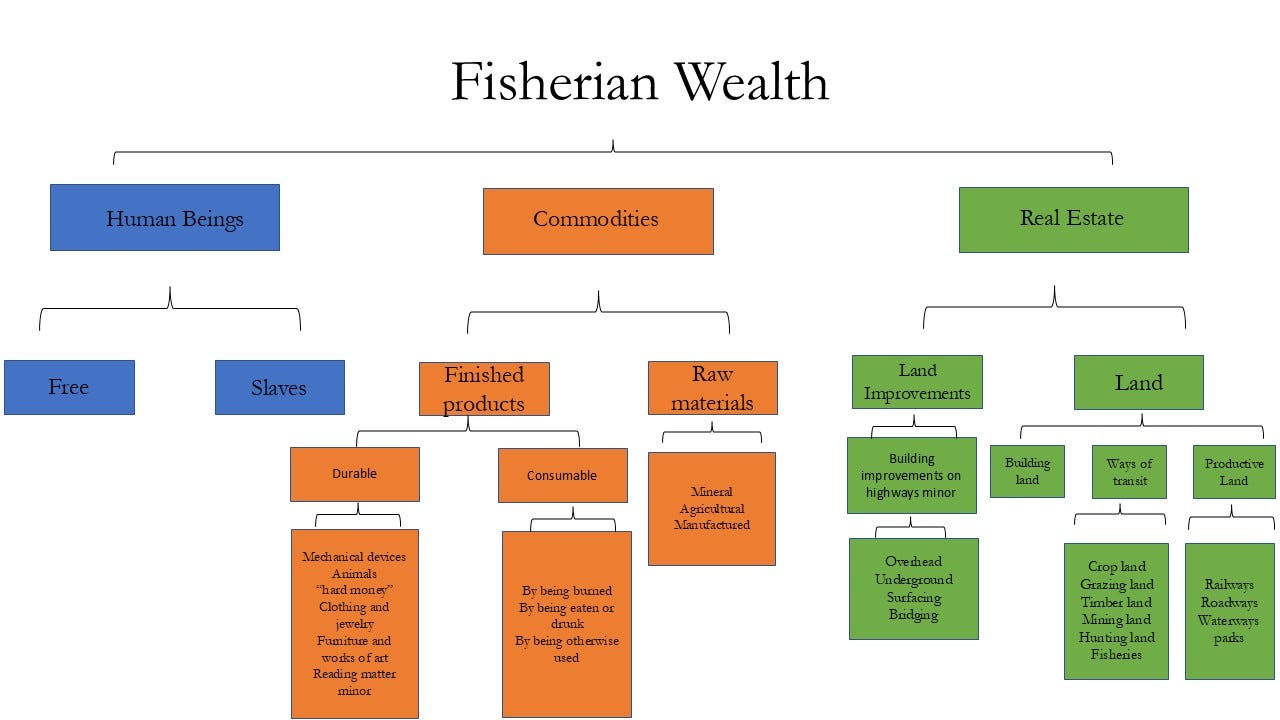
Later economists tried to formalise this idea, though not always cleanly. Irving Fisher gave a more structured definition of wealth, dividing it into humans, commodities, and real estate, measured in both physical quantities and value terms.
In the mid-20th century, Anthony Scott pushed the idea further by treating natural resources explicitly as part of the capital stock, inputs that must be combined with labour and other inputs to produce goods and services. This was followed up by a steady stream of contributions from some heavyweights of 20th century economics (Martin Weitzman, Robert Solow (and part 2), Partha Dasgupta, Joseph Stiglitz, John Hartwick). Although these contributions were inspired the 1970s oil crisis, their central message was the importance of capital, broadly defined.
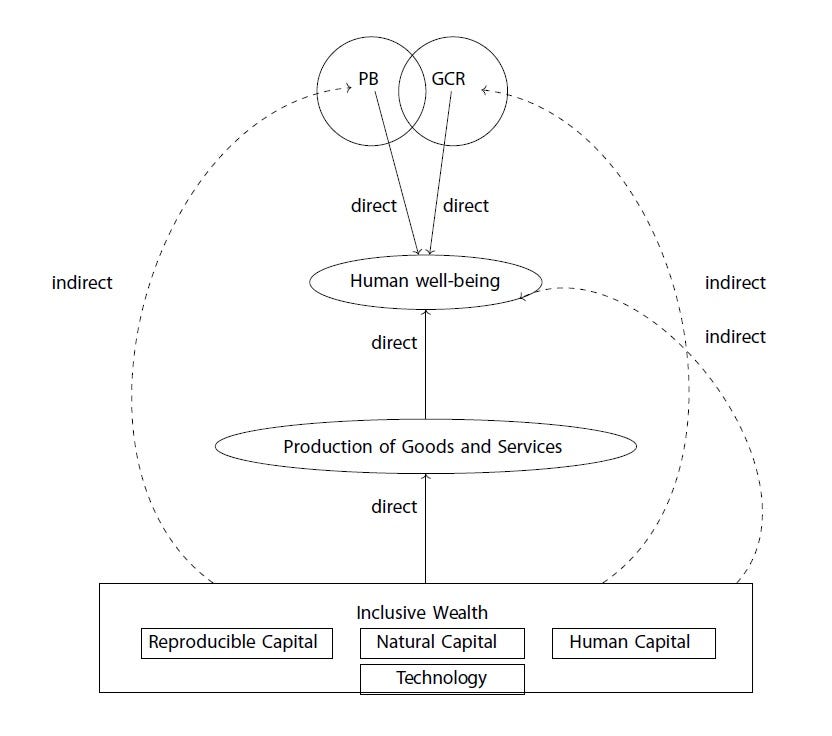
That line of thinking leads directly to the modern view. Wealth is no longer just produced capital. It includes human capital and natural capital as well. Frameworks like the World Bank’s wealth accounting (see CWON 2024) and the UN’s Inclusive Wealth reports (see IWR 2023) build on this. The shift is simple but important: wealth is a portfolio, not a single number. I explore this idea in more detail in my recent book on inclusive wealth.
So why does any of this matter now?
Because how we define wealth shapes how we think about risk.
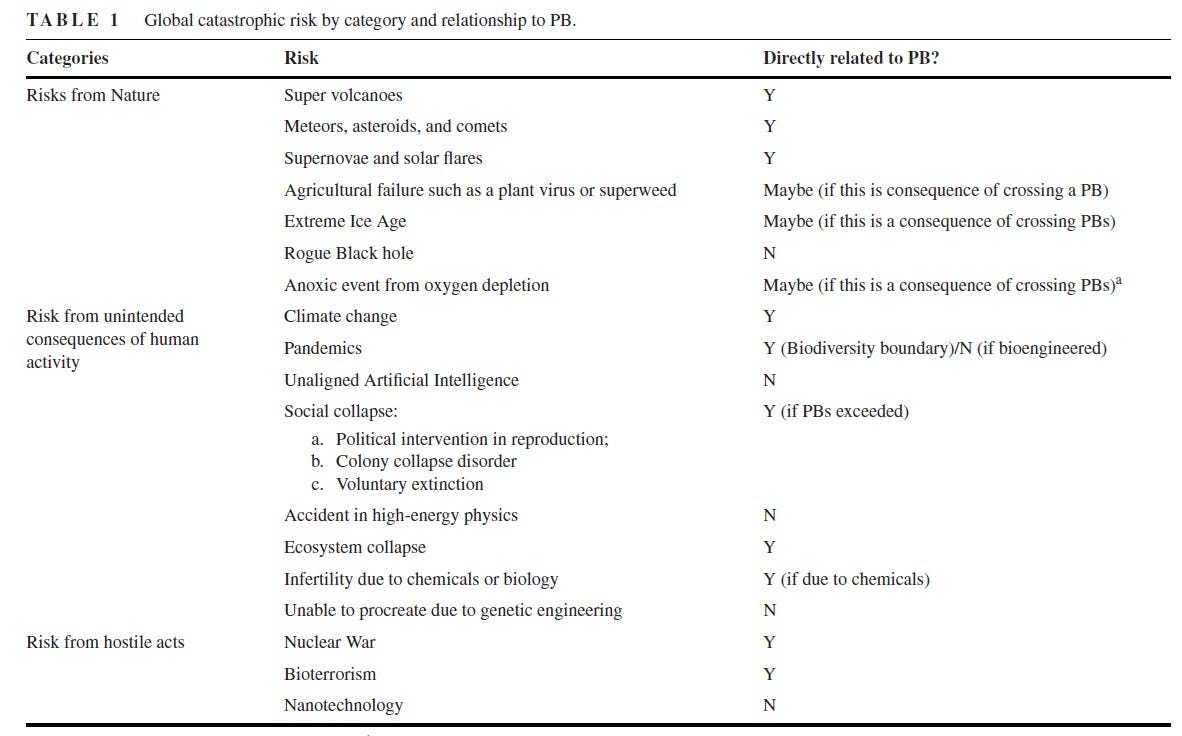
There is a growing literature on existential risk. These risks that could seriously damage or even end human civilisation (see Global Catastrophic Risks and The Precipice). This work splits broadly into two camps: one focused on Planetary Boundaries and another on Global Catastrophic Risk. They often talk past each other, but both are concerned with long-run human well-being.
Some risks are external – asteroids, solar flares, super volcanoes. Others are endogenous: they emerge from economic activity itself. Some risks fall squarely within global catastrophic risk, while others overlap with Planetary Boundaries (see figure 3).
This brings us back to Smith’s question. If wealth is capital, broadly defined, then managing risk means protecting that capital stock.
In recent work (with Matthias Beck), we argue that inclusive wealth provides a better way to think about these risks. It forces attention onto the underlying assets that sustain well-being, especially natural capital, which is often degraded or ignored (the general idea is outlined in Figure 4).
Smith also offers a useful behavioural insight here: ‘the chance of gain is by every man more or less overvalued, and the chance of loss by most men undervalued’.
That feels uncomfortably current. When it comes to large-scale risks, especially slow-moving ones like environmental degradation, we tend to underweight the downside.
Revisiting The Wealth of Nations isn’t about returning to 18th-century economics or 18th-century politics. It’s about recovering a way of thinking that puts real assets, not just financial ones, at the centre of the analysis.
And once you do that, the problem of risk looks very different.