A War on Two Fronts
Suez and the End of British Power

On 5 November 1956 Britain invaded Egypt. Within days, it was fighting for the pound. The military operation at Suez is usually remembered as the last gasp of British imperialism, but the real humiliation came in the foreign exchange markets. As British forces moved toward Port Said, markets moved against sterling. The run on the pound mattered more than the fighting on the ground. Britain could not continue the war without American financial support, and Washington refused. Suez was not simply the end of empire; it was the moment Britain learned that military power meant little if it could not defend its own currency. Later, Harold Macmillan wrote that the pressure on sterling was ‘greater than [he] had anticipated’, helping explain why the conflict ended so abruptly.[i]
I initially approached the Suez crisis from the perspective of Irish macro-economic history. The 1950s was a period of periodic balance of payments crises in Ireland (and the UK) and one of the worst recessions in modern Irish history following a monetary experiment where Irish officials refused to follow British monetary policy.[ii] Ireland’s economic problems started with a weakened sterling that was a drag on the Irish economy. What Irish officials did not realise was that sterling itself was under sustained speculative attack from 1955 onward, before, during, and after Suez. The back story to the Irish experiment was the travails of sterling as an international reserve currency, what the economic historian Maylis Avaro calls a ‘zombie reserve currency’.[iii]
The Suez crisis is usually told as a story of diplomacy and imperial decline. But it was also a story about money, and about another defining feature of twentieth-century British history: relative economic decline. The Suez crisis exposed that decline and was shaped by it. Britain fought two wars in 1956: one in Egypt and one in the foreign exchange markets.
Suez in the new world order
The Suez crisis began with Colonel Gamal Abdel Nasser’s nationalisation of the Suez Canal in July 1956 and ended with a forced ceasefire and a run on sterling only months later. Militarily, the Anglo-French-Israeli invasion was not a defeat; however, politically and financially, it was disastrous.
The canal mattered because it was the artery of oil and imperial trade between the Middle East and Western Europe. Britain had already been shaken by the nationalisation of the Anglo-Iranian Oil Company in 1951. Losing control of the Canal so soon after losing influence over Iranian oil made Suez feel like part of a wider imperial retreat.[iv]
For Israel, the canal itself was never the central issue. The deeper concern was Egyptian power and access through the Straits of Tiran after Nasser’s growing military strength and the Soviet-backed arms deal of 1955. Suez was presented publicly as a dispute over navigation and international law, but it was also a preventative war shaped by fears of a changing regional balance of power.
To Anthony Eden and Harold Macmillan, Nasser was not merely an Egyptian nationalist but another Mussolini: an aggressor who had to be stopped early, before appeasement made the problem worse. The memoirs of Eden and Macmillan are full of comparisons to the 1930s. Delay, in their minds, meant Munich. [v]
Washington saw things differently. The Eisenhower administration had little interest in defending old European imperial privileges. The United States wanted Arab nationalism kept away from Soviet influence and did not want to appear to support imperial intervention while condemning Soviet repression in Hungary.
The immediate trigger of the crisis was Washington’s abrupt withdrawal of support for the Aswan Dam project, a major prestige project for Nasser’s regime.[vi] Washington’s volte face was driven by an arms deal that Egypt negotiated with the Soviets.[vii] The Egyptian response was to nationalise the canal, presenting it as a way to finance the dam itself.
Britain and France chose to respond with force. In secret coordination with France and Israel, Britain backed a plan in which Israel would attack Egypt first, allowing Britain and France to intervene as supposed neutral peacekeepers to ‘protect’ the canal. The military operation was limited and ‘hopelessly ill prepared’.[viii] The decisive problem was that Britain had launched the operation without American support.
Eisenhower refused to back the invasion. Worse, Washington refused financial support as sterling came under pressure. Suez was the moment Britain discovered that military ambition without economic and financial independence was dependence disguised as strength.
Relative Economic Decline
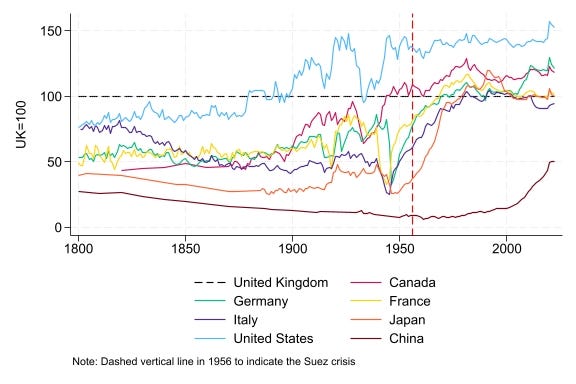
Britain was the first industrial nation and for much of the nineteenth century the richest and most powerful country in the world. By the mid-twentieth century, that position had changed. Britain was still wealthy, but it was no longer dominant – as shown in figure 1. The United States had overtaken it.[ix]
Source: Bolt & Van Zanden (2024).
Suez is often remembered as a diplomatic humiliation or the last act of empire, but it was also a test of Britain’s underlying economic strength. The economic historian Sidney Pollard argued that Suez should not be seen as an external shock to Britain’s postwar economy but as something ‘symbolic’. It revealed how little economic room Britain actually had for imperial adventures although politicians still imagined Britain as a great power; the balance sheet suggested otherwise.[x]
Some historians have pushed back against the language of ‘decline’, arguing that Britain remained prosperous and that too much emphasis is placed on GDP rankings.[xi] This is true to a point, Britain in 1956 was not a poor country but sterling told a different story.[xii] The pound had already been devalued in 1949 and remained vulnerable. Confidence in sterling mattered because Britain still depended on it as both a domestic currency and an international reserve currency.
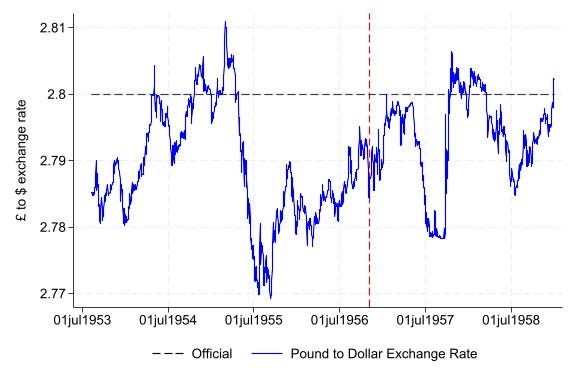
When Suez escalated, pressure on the pound intensified rapidly – see figure 2. Reserves decreased by $57 million in September 1956 and $84 million in October but then fell sharply by $279 million in the first few days of November. Macmillan turned to Washington and the IMF but was rebuffed. That refusal mattered more than the fighting in Egypt.
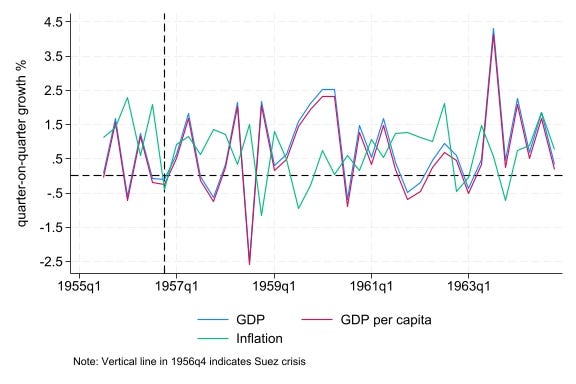
Macmillan realised before Eden that Britain could not continue the war. ‘A minor colonial conflict had’, as Andrew Shonfield put it, ‘rocked the pound sterling to its foundations.’ [xiii] Suez did not bankrupt Britain, and the domestic economic effects were manageable (see figure 3).[xiv] But that misses the point. The lesson was political: Britain could no longer wage even a limited war without American financial consent.
The “Special Relationship”
Suez did not end Britain’s ambitions but it ended the illusion that those ambitions could be pursued independently of the United States. Since 1956, every British prime minister has governed in the shadow of that lesson: military power without financial power is dependence disguised as strength.
The Suez crisis becomes most pertinent whenever a Western power intervenes in the Middle East. However, the political scientist Scott Lucas warned readers of looking at events in the Middle East through a ‘Western prism’ and ‘of superficial parallels between the Suez and current events’.[xv]
The Suez episode matters because Western powers keep repeating versions of it. A great power, convinced of its own strategic necessity, launches a secretive intervention in the Middle East, dismisses the United Nations, underestimates regional consequences, and discovers that military superiority does not guarantee political control. In 1956 it was Cold War rivalry and the defence of empire. In 2026 it is strategic competition between great powers, the shadow of American retrenchment, and the same illusion that force can substitute for political settlement.
That is why Suez still matters beyond diplomatic history. It speaks directly to current arguments about Europe’s power in a world shaped by American retrenchment and renewed great-power rivalry. Europe is not poor in the ordinary sense. It is wealthy, productive, and still among the richest regions in the world. Paul Krugman is right to reject the lazy declinism that treats slower growth as civilisational collapse. But Suez reminds us that strategic power is not measured only in GDP per head. Britain in 1956 was still a rich country. It retained global military reach, prestige, and nuclear ambitions. What it lacked was the financial independence to sustain action once Washington said no. The question was never simply wealth, it was dependence.
[i] H. Macmillan (1971). Riding the storm, 1956-1959. London: Macmillan.
[ii] D. McLaughlin, E. McLaughlin, and S. Kenny (2025). Taking a Punt: Monetary Experimentation and the Irish Macroeconomic Crisis of 1955-56. QUCEH WP 25-02.
[iii] M. Avaro (2024). Zombie International Currency: The Pound Sterling 1945–1971. Journal of Economic History. 84(3): 917-952.
[iv] R. Crockatt (1995). The Fifty Years War: The United States and the Soviet Union in World Politics, 1941-1991. London: Routledge.
[v] A. Eden (1960). Full Circle; Macmillan, H. (1971). Riding the storm, 1956-1959.
[vi] A. Eden (1960). Full Circle: The Diaries of Anthony Eden. Riverside Press: Cambridge; Macmillan, H. (1971). Riding the storm, 1956-1959. London: Macmillan.
[vii] A. Hewedy (1991). Nasser and the crisis of 1956. In Wm Roger Louis and Roger Owen (ed). Suez 1956: The Crisis and its Consequences. Oxford: Oxford University Press.
[viii] E. Heath (1998). The Autobiography of Edward Heath: The Course of My Life. London: Hodder and Stoughton.
[ix] N. Crafts (1998). Forging Ahead and Falling Behind: The Rise and Relative Decline of the First Industrial Nation. Journal of Economic Perspectives. 12 (2): 193–210; N. Crafts (2018). Forging Ahead, Falling Behind and Fighting Back. Cambridge: Cambridge University Press.
[x] S. Pollard (1982). The Wasting of the British Economy.
[xi] B. Supple (1994). Fear of Failing: Economic History and the Decline of Britain. The Economic History Review, 47 (3), pp. 441-458; J. Tomlinson (1991). Inventing ‘Decline’: The Falling behind of the British Economy in the Postwar Years. Economic History Review, 49 (4), pp. 731-757; J. Tomlinson (2023). Imagining Economic Growth in Post-War Britain. Modern British History, 34(4): 754-779.
[xii] A. Klug & G. W. Smith (1999). Suez and sterling, 1956. Explorations in Economic History, 36(3), 181-203.
[xiii]A. Shonfield (1958). British Economic Policy Since the War. London: Penguin.
[xiv] J. Dow (1964). The Management of the British Economy 1945-60. Cambridge: Cambridge University Press, p. 94.
[xv]W. S. Lucas (1991). Divided We Stand: Britain, the US, and the Suez Crisis. London: Hodder & Stoughton.